Table Of Content

This article explores these two management styles, delving into their characteristics, the environments in which they thrive, and the outcomes they typically produce. This program demonstrates a top-down design approach by breaking down the game into smaller, manageable functions that represent different sections of the adventure. Firstly, the main() function acts as the entry point and orchestrates the flow of the game. Ask_player_name() interacts with the player and retrieves their name, which is then used by other functions. Start_adventure() prompts the player to make a decision that determines the course of their journey. Based on the decision, either explore_cave() or trek_forest() is called, each representing a different path in the adventure with simple binary outcomes.The design is modular, allowing for easy maintenance and clear structure.
Fix these common onboarding challenges to boost productivity
This article will look at the top-down vs bottom-up approach to project management and see which works better for different situations. To design a system to support all these cases requires sufficient time. We must identify these nonfunctional requirements as part of your top-down design. Once we have identified and done a deep dive of functional requirements with the help of top-down design.
How Master Modeling Can Speed Up Product Development
The top-down approach is used to maintain strategic alignment, control, and consistency across an organization. It effectively manages large-scale projects, ensures compliance with regulations, and implements clear and unified organizational goals. When choosing the best approach, consider a hybrid approach that combines top-down and bottom-up elements. Many successful organizations find that a balance of these approaches allows them to benefit from structured strategic alignment while also capitalizing on their employees' innovative potential.
Top-Down Design — an Approach for Flawless Software Design and Implementation
Once you’ve nailed down the main problem, the next step is to break it down into smaller, manageable sub-problems. It’s akin to dividing a big task into smaller to-do lists; each sub-problem becomes a mini-puzzle waiting to be solved. ClickUp makes collaborating on projects and managing workflows straightforward. Its hierarchy framework neatly organizes the most complicated projects into tasks and subtasks.
Product design and development
It is important to consider non-functional requirements like security and performance as well at each stage. It will ensure the system designed performs at higher load or required load and secure. For example, in the above list user, course, exams, grades are all different systems on their own. Reports modules will have to interact with all these systems to get the data required for the report.
These elements are then linked together to form larger subsystems, which then in turn are linked, sometimes in many levels, until a complete top-level system is formed. This strategy often resembles a "seed" model, by which the beginnings are small but eventually grow in complexity and completeness. But "organic strategies" may result in a tangle of elements and subsystems, developed in isolation and subject to local optimization as opposed to meeting a global purpose.
call us at 312•226•8339 to speak with an account manager about our remote training services
In programming lingo, this means looking at the overall structure of your code before diving into the individual functions and lines. Different product teams take different product management approaches. Making critical decisions and overseeing the product development process from conception to market introduction is part of product management. Modern software design approaches usually combine top–down and bottom–up approaches.
Component-level revision control is required
Bottom–up control in ecosystems refers to ecosystems in which the nutrient supply, productivity, and type of primary producers (plants and phytoplankton) control the ecosystem structure. If there are not enough resources or producers in the ecosystem, there is not enough energy left for the rest of the animals in the food chain because of biomagnification and ecological efficiency. An example would be how plankton populations are controlled by the availability of nutrients. Plankton populations tend to be higher and more complex in areas where upwelling brings nutrients to the surface.
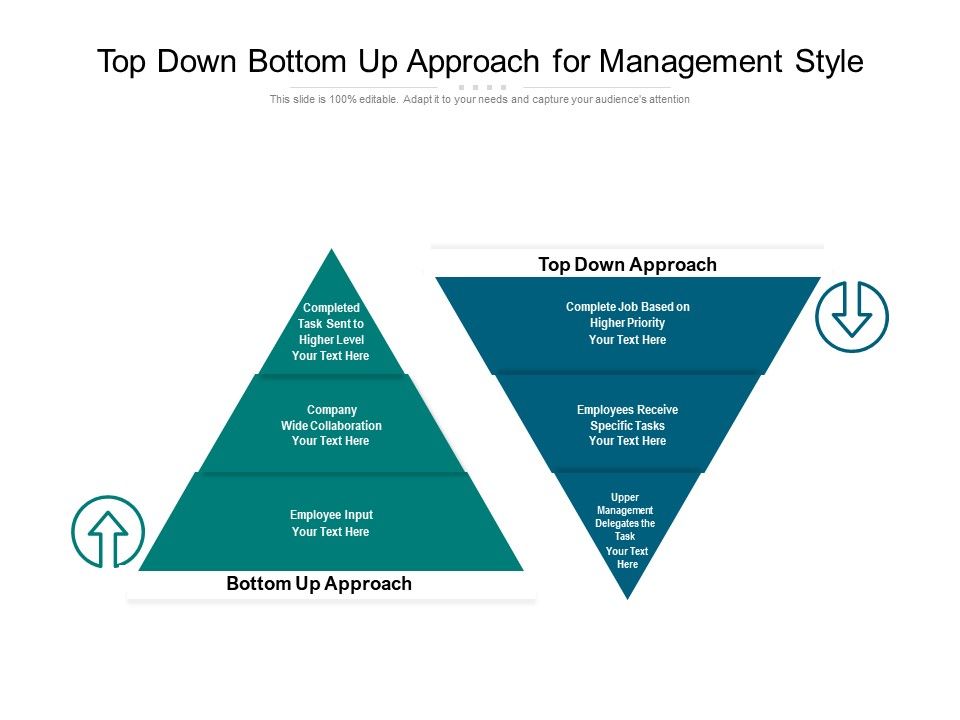
Top Down Design is like constructing a building; you start with the blueprint and work downwards. Bottom Up Design, on the other hand, is akin to building blocks; you begin with the foundation and stack upwards. Both have their merits, but the key lies in choosing the right approach for the task at hand.
In collaborative settings, those who work directly on projects and oversee project management can speak to the decisions that will impact their future work. Upper managers work directly with team members to chart a course of action, which prevents potential process blind spots that might otherwise appear when decisions are made without team input. The bottom-up style of management solves many of the problems that come with the top-down approach. This approach has advantages that make it a great fit for creative teams and industries where collaboration is key, like software development, product design, and more.
Top-Down Construction: Engineering Solution Reduces Costs and Carbon - Urban Land
Top-Down Construction: Engineering Solution Reduces Costs and Carbon.
Posted: Mon, 10 Jul 2023 07:00:00 GMT [source]
The top-down approach will miss the creative input and unique ideas the team could bring. First, each function is checked for correct operations with both valid and invalid inputs. When errors are found, then they are corrected or the design and/or requirements are reviewed for problems and possibly updated. It will help you to identify the measures must be taken to support such a big expectation. It must be handled at the design phase so that the implementation is done correctly and performs as expected.
Top down design evolved from designers making assembly references from one part to another, where upon, submission to PDM tools of the time filled up the relatively small hard drives (circa 1993). System Administrators or SYSOP’s, basically managers of working & production PDM database models, became frustrated that the database was filling up quickly because of all the references. They also became frustrated that users created circular references within assemblies. This feature and subsequent part was first new in v20 of Pro/ENGINEER (circa 1998). In practical terms, this means that the project leader or manager takes charge, analyzing the project as a whole and breaking it down into smaller, manageable tasks. Like our chief architect, they set the goals, allocate resources, and define the project’s overall structure.
Top-Down design is not a process that is limited to network design; it is a concept that can be used for many other applications. Top-Down network design is simply the analysis of the needs of companies from a high level. Instead of starting a design by choosing the equipment, the design starts by taking the company requirements and needs analysis information and using it to derive a design based on high-level functional requirements.
Today, very few organizations apply a purely top-down approach to management. Most teams apply a hybrid approach that falls somewhere along a spectrum of combinations between top-down and bottom-up management styles. The top-down approach to management is a strategy in which the decision-making process occurs at the highest level and is then communicated to the rest of the team. This style can be applied at the project, team, or even the company level, and can be adjusted according to the particular group’s needs.
Top-Down and Bottom-Up Urban Planning: A Synergetic Approach - ArchDaily
Top-Down and Bottom-Up Urban Planning: A Synergetic Approach.
Posted: Mon, 21 Aug 2023 07:00:00 GMT [source]
After finalizing the initiatives, the board and the product leaders might want to hold a workshop to brainstorm features that fit into each objective. With all communication flowing from leaders to team members with little room for dialogue, the top-down approach allows fewer opportunities for creative collaboration. Less interdepartmental collaboration may also eliminate fresh perspectives and stifle innovation. Top-down design helps in organizing and structuring your code in a logical and easy-to-understand manner.


No comments:
Post a Comment